
Francis Asbury (1745-1816) was the first general superintendent or bishop of American Methodism. He was born near Birmingham in England and came under Methodist influence at an early age. Asbury was accepted as a local preacher at the age of eighteen and joined the itinerancy four years later. At the 1771 Conference, he was one of five volunteers to go to America.
At first subordinate to senior colleagues like Joseph Pilmore and Richard Boardman, within twelve months of his arrival Asbury was appointed by John Wesley to be his temporary assistant in charge of all American work. During the War of Independence, Asbury was the only British Methodist preacher to remain in America and his pre-eminent position was confirmed by John Wesley in 1784, when he was consecrated general superintendent, a position which he held jointly with Dr Thomas Coke.
For thirty years Asbury made annual tours of the eastern United States, preaching sermons and administering to the far-flung Methodist congregations. During his lifetime and at least partly due to his influence and supervision, the American Methodist Church expanded to become one of the most important Protestant denominations in the United States.
Encyclopedia of World Methodism (1974) and Dictionary of Evangelical Biography 1739-1860, edited by Donald M. Lewis (1995)
(Bishop Richard) Whatcoat, who accompanied Asbury, says they reached the Roanoke on January 14 and slept at Stephen Shels in Warren County, North Carolina. Asbury preached, and the exhorter was Philip Bruce, a North Carolinian who was presiding elder of the north district in Virginia. Bruce was of Huguenot descent and a zealous patriot who was present “as a sort of chaplain” at the battle of King’s Mountain near his birthplace. On the fifteenth they rode to “Widow Pegram’s,” where Bruce exhorted and the sacrament was administered. They slept that night at John Falcon’s in Warren County. Whatcoat’s spelling is very uncertain.
Journal of Bishop Richard Whatcoat, printed by Sweet in Religion on the American Frontier, The Methodists, 90.
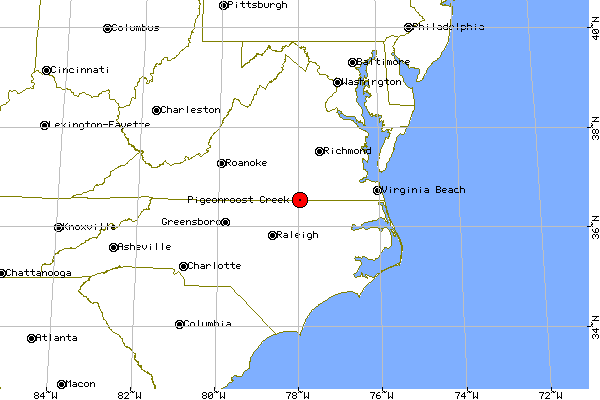
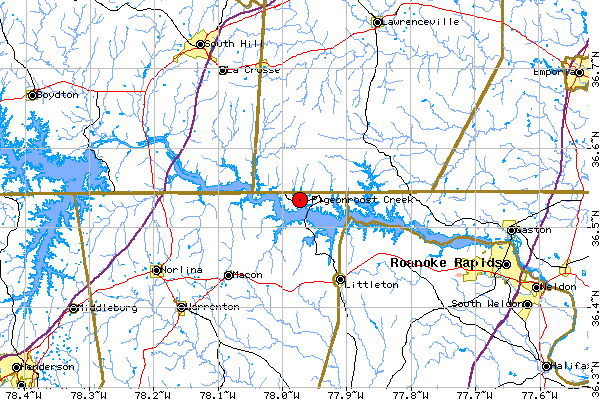
Sunday, 12. I was called upon by recommendation to ordain Stephen Shell, John Wallis, and David Owen, to the office of deacons. There were seven of us present who minister in holy things. My subject was 2 Timothy 4:1, 2: “I charge thee therefore, before God, and the Lord Jesus Christ, who shall judge the quick and the dead at his appearing and his kingdom, preach the word; be instant in season, out of season; reprove, rebuke, exhort, with all long-suffering and doctrine.” It was observed of St. Paul, that before finishing his course, he had adopted Timothy, ordained him, and left this charge, a dying charge given by a dying, martyred apostle of the Lord Jesus Christ; and left on record for all who ordain, and all who shall be ordained to the ministry to the end of the world! a charge given as in the immediate presence of God, whose attributes and perfections are great and glorious; “and the Lord Jesus Christ,” in his Divine character; and in his important offices and relations to mankind; ministers being his servants, the people his flock, and the word his own eternal word of truth and salvation; who is now, and shall be hereafter, the Judge of all our actions. “Preach the word”-the word of repentance, of faith, of justification, of regeneration, and of sanctification. “Reprove”-there are special uses to be made of the word to convince sinners of all degrees, classes, characters, and modes of faith. “Rebuke”-rebuke backsliders; rebuke errors in practice, and negligence in duty. “Exhort”-exhort souls rebuked and convinced, to seek the restoring, preserving grace of God. It was shown how ministers should time their labours, regulating them as favourable or unfavourable seasons would seem to require; and the necessity of preserving the faith and meekness which might enable them to labour “with all long-suffering and doctrine.”
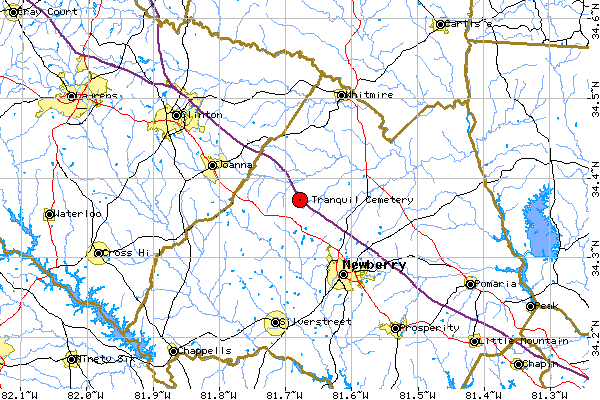
Sunday, 12. I preached to about one thousand people, on Titus 2:1. The quarterly meeting engaged our attention six hours every day. Our route on Monday lay over Bush Creek. This is, or was, a Quaker settlement: the Friends have gone to rich lands, unpolluted by slavery- they have formed a settlement in Ohio. I preached in Tranquil chapel on Tuesday-God has blessed Stephen Shell’s family. Grandmother, who was waiting in great peace for her summons, was called away in August last. I must needs preach at Major’s chapel: my subject was the great salvation. Lodged with Colonel H. Herndon. O how kind! Thursday, rode to Jeremiah Lucas’s. I was in heaviness of mind, and suffered in the flesh. Brother Boehm preached in the chapel.
Wednesday, 16. Dined with elder Stephen Shell. Lodged with Frederick Foster. Thursday, we had a crowded house at Hopewell chapel: the speaker stood in weakness, but truth came in power to the hearts of the people. Ordained John Molineaux a deacon. Lodged at John Leak’s: the master, a local labourer, is gone to his rest and reward.
Elmer T. Clark, ed. with J. Manning Potts and Jacob S. Payton. The Journal and Letters of Francis Asbury. Abingdon Press. Nashville. 1958.

Return to Dan & Cindy's home page by clicking HOME.
Click EMAIL to submit corrections, additions, or otherwise let us know
what you think. SURNAMES is the genealogy home page with an index to check
for a connection to your family.
If you find one, let us know!
Page built by Gedpage
Version 2.05 ©1997 on 3 May 2002