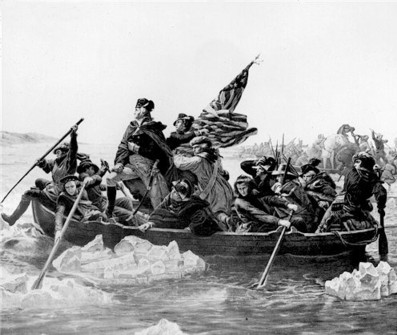
Washington Crosses the Delaware
and the
Battle of Trenton
December 25, 1776 - January 3, 1777
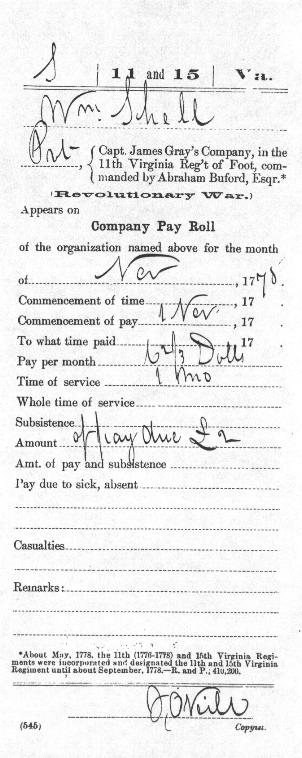
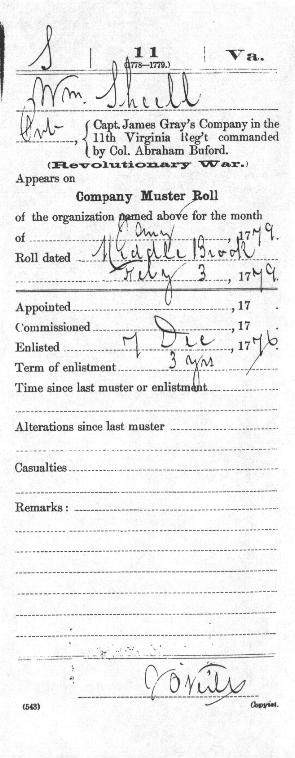
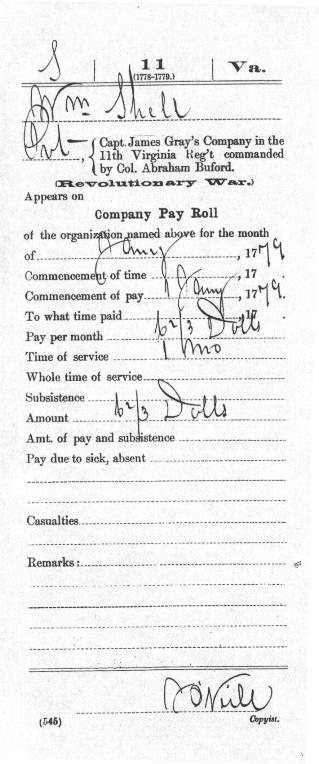
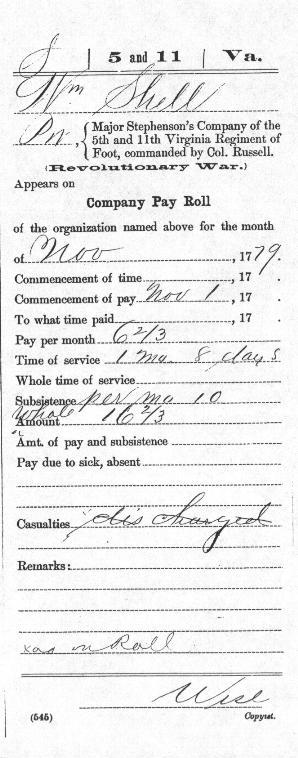
William Shell (or *William Shell) joined the Continental Army and departed Virginia for the fighting in the north between December 7, 1776 and June of 1777. During his time of service, he was involved in some of the most important conflicts of the Revolution at places which have become legendary in American history. In November of 1779, his enlistment ended and he was discharged at Camp Morristown in New Jersey. He returned to his home on the Roanoke River's Pigeonroost Creek in Brunswick County of Virginia, near the Virginia-North Carolina "country line," just as the the Carolina campaigns gained strategic importance and the theater of war moved to his neighborhood.
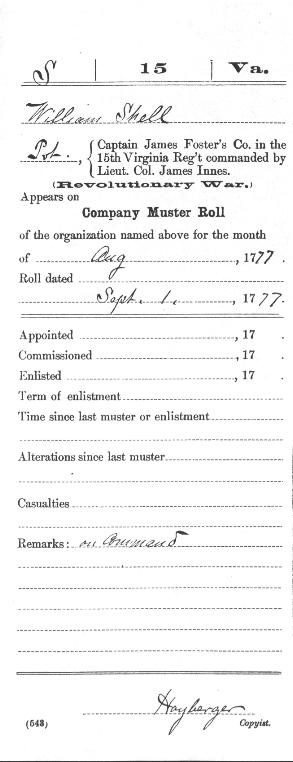
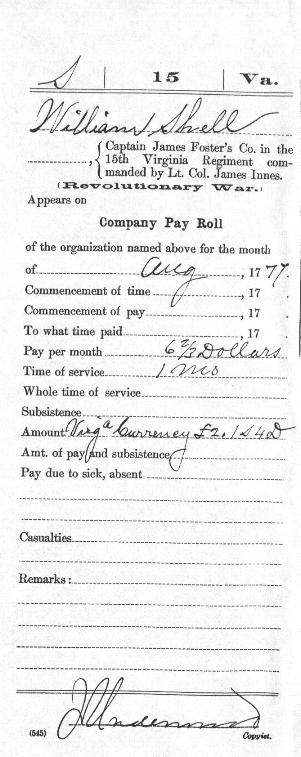
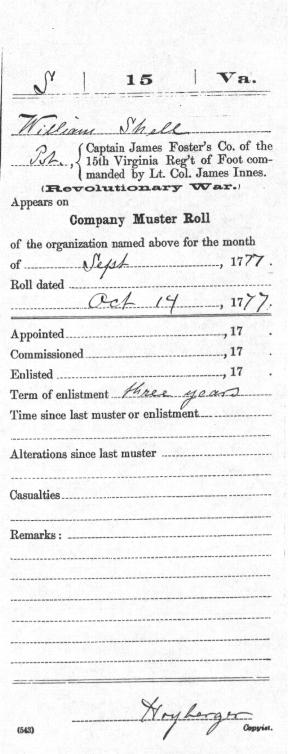
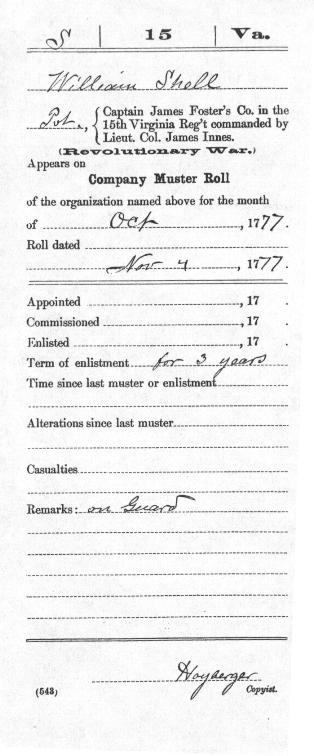
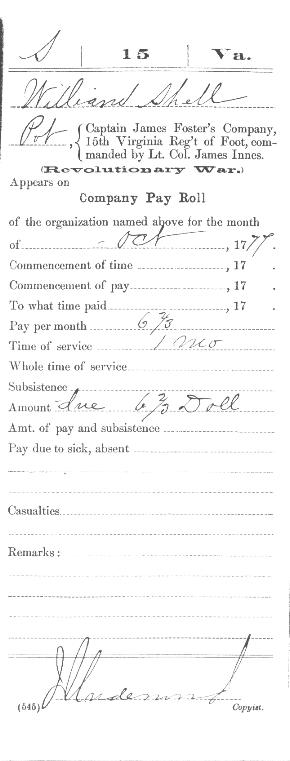
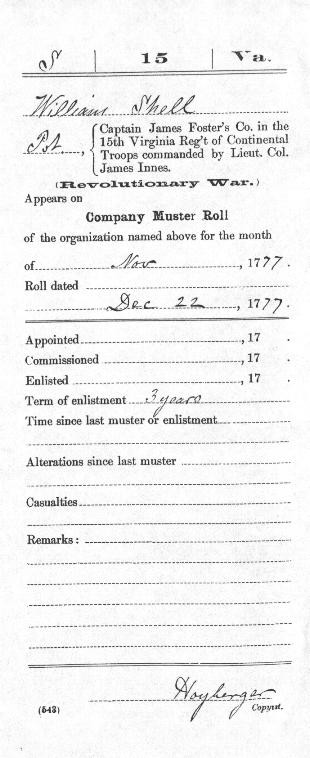
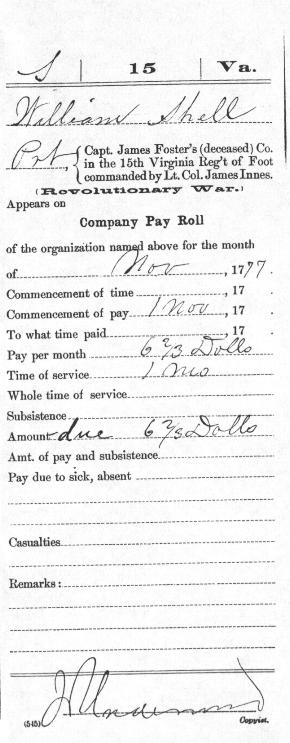
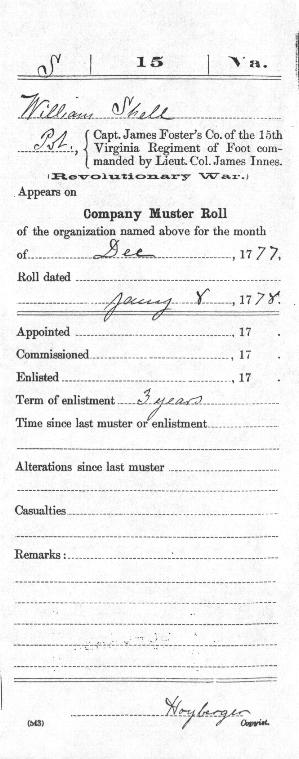
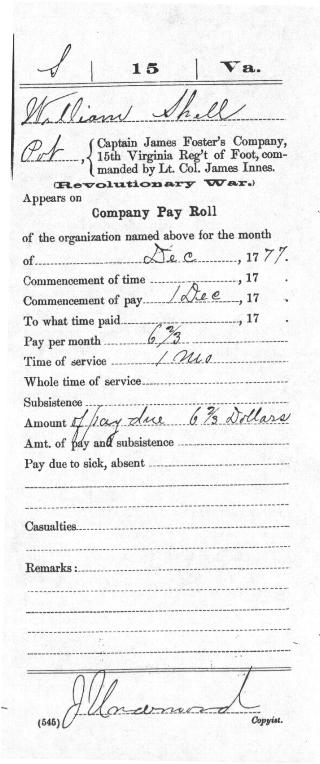
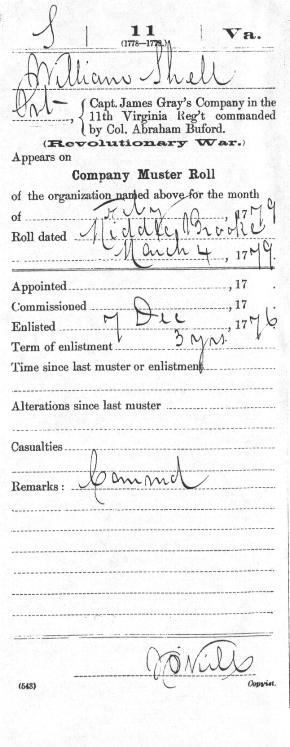
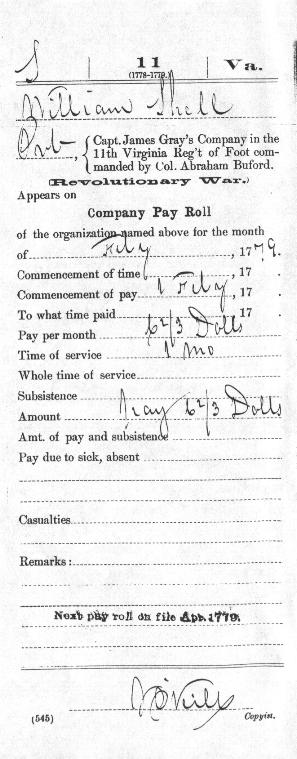
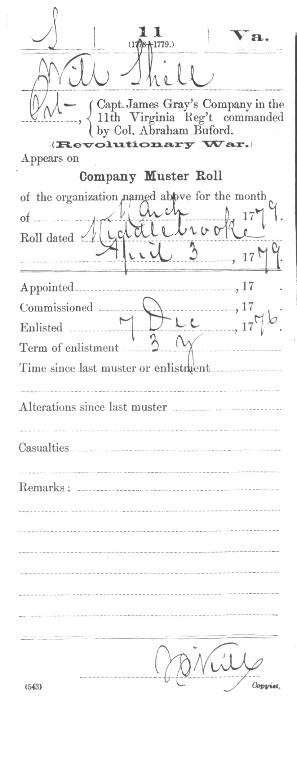
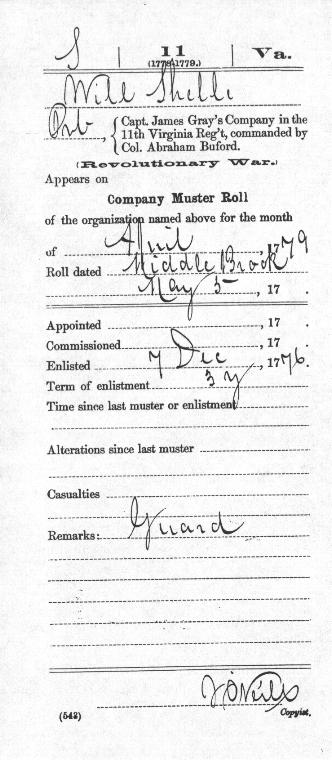
As part of the Franklin D. Roosevelt administration's "New Deal" remedies for "The Great Depression," Revolutionary soldiers' military service records in the National Archives were transcribed from the original documents to more legible and durable indexed cards. Here these transcriptions of William Shell's service records, muster rolls and pay rolls, are displayed in chronological order along with descriptions of historical events, individuals, and images with which he was likely familiar. Sources for all historical information are cited, with links where available, immediately following the articles. Thanks to Rebecca Goff for submitting copies of William Shell's service records for inclusion here.
Washington Crosses the Delaware
and the
Battle of Trenton
December 25, 1776 - January 3, 1777
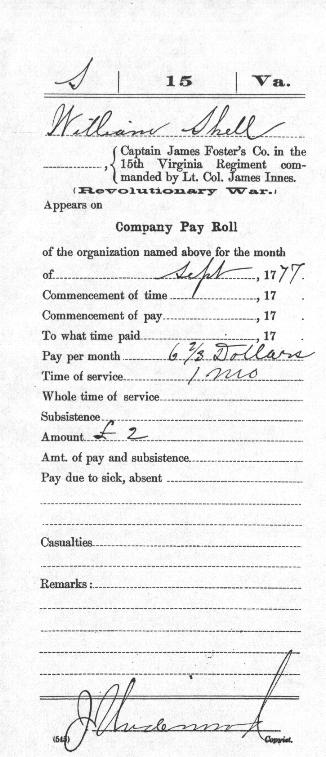
William Shell's date of enlistment, shown on the first available of his service records below, is indicated as December 7, 1776. This was just under three weeks before General Washington's famous crossing of the Delaware and the ensuing Battle of Trenton in which he caught the Hessians encamped there by surprise and captured the town. If William Shell was not yet attached to the 15th Virginia by this time, he would have reported to his company in their winter encampment at Morristown, New Jersey from January 6 until May 28, 1777.
 |

|
In 1775, Captain James Innes was ordered by the House of Burgesses to organize a volunteer company of men in the city of Williamsburg to guard the public magazine. In February of 1776, the Virginia Gazette mentions that he was chosen captain of an artillery company at Williamsburg, Virginia. By the following November James appeared as a lieutenant colonel. As a lieutenant colonel of the 15th Virginia Regiment and sometime aide to Washington, James served at Trenton, Princeton, Brandywine, Germantown and Monmouth before resigning his commission.
Susan Innes Kitchens, 1994.
http://www.tennkin.com/hist/innes_history.htm
Innes, James, 1754-98, American lawyer, b. Caroline Co., VA. As commander of a Virginia regiment, he took part in many battles of the American Revolution. He was president of the board of war for Virginia (1779) and a member of the state legislature (1780-82, 1785-87). A noted lawyer, considered second only to Patrick Henry as an orator, Innes was chosen to make the final appeal for adoption of the Constitution in the Virginia ratifying convention (1788) and greatly impressed all those present. He defeated (1786) John Marshall for the office of attorney general of Virginia, but he declined an appointment as U.S. Attorney General.
See study by J. Carson (1965).
The Columbia Electronic Encyclopedia, 6th ed. Copyright © 2003, Columbia University Press.
http://www.infoplease.com/ce6/people/A0825247.html
 |

|
 |
|
On July 22, Sir William Howe had sailed out of New York Harbor with a fleet of 267 ships carrying 18,000 soldiers, and vanished over the horizon, bound, it was thought, for Philadelphia. A week later the ships appeared in Delaware Bay, only to disappear again, which led to days of tension and speculation as to Howe's intentions. (John) Adams interpreted such feints and maneuvers to mean the real objective was the Hudson, where Howe would join forces with Burgoyne, but then Adams decided an invasion of Philadelphia must be the plan after all. If Howe's army was at sea all this time, he speculated to Abigail, the men between decks must be suffering beyond expression.
Howe's fleet was sighted in Chesapeake Bay on August 21. Three days later, in a show of resolve, Washington paraded his troops through Philadelphia, every man wearing a sprig of green as an emblem of hope. Adams felt a lift of heart at the sight. His hard work with the Board of War had had some effect. They looked well armed and tolerably well clothed, he thought, if a bit out of step.
David McCullough. John Adams. Simon & Schuster, New York, 2002. pp. 172-173.
Washington kept his army protected in quarters at Morristown until June, but even when he moved out he kept to the hills and ridges knowing he would be demolished if he met the British General Howe on the open plains. August found Washington and his troops in camp about twenty miles from the Rebel Capitol of Philadelphia, when he received word that Howe was landing his forces in Chesapeake Bay. Washington rightly assumed Howe's target was the Capitol and moved quickly to position his army between that city and the enemy. In an effort to gain added support and volunteers for his army and to give his soldiers added confidence, he decided to parade his troops through the streets of Philadelphia on his way to meet General Howe. The soldiers polished themselves, their clothes, and their arms, and to offset the shabbiness of the uniforms, each man was ordered to wear laurel leaves in his hat, a "green sprig, emblem of hope." The camp followers of women and children were all lead on an alternate route around the city.
The army started for the city at three in the morning on Sunday, August 24. At seven they reached Philadelphia. It was raining early in the morning but John Adams reported to his wife Abigail:
| The rain ceased, and the army marched through the town between seven and ten o'clock. The wagons went another road. Four regiments of light horse...Four grand divisions of the army and the artillery...marched twelve deep and yet took up above two hours in passing by. The army...I find to be extremely well armed, pretty well clothed, and tolerably disciplined. General Washington and the other general officers with their aides on horseback (Scheer & Rankin, p. 265). |
The Marquis de Lafayette, Washington’s new 19-year-old colleague who would become a lifelong friend, could hardly believe his eyes. "About 11,000 men," he wrote, "poorly armed and miserably clad, offered an amazing display; among the motley assortment of dress and occasional undress, the best garments were hunting blouses, loose fitting gray sailcloth jackets..."
John Adams joined his fellow members of the Continental Congress in reviewing the army from the steps of the State House (Independence Hall). Trying to be sympathetic, he confessed in a letter to his wife, Abigail: "Our soldiers have not yet quite the air of soldiers. They don’t stay exactly in time. They don’t hold up their heads quite erect, nor turn their toes so exactly as they might. They don’t all of them cock their hats; and such as do, don’t all wear them the same way."

Independence Hall in Philadelphia, where the Continental Army passed in review before the Continental Congress.
A newspaper devoted only a terse paragraph to the event: "On Sunday, the 24th of August, the main body of the Continental army... marched into Philadelphia, proceeded to the common [roughly where City Hall stands], crossed the new floating bridge [of logs] over the Schuylkill river at the middle ferry [today’s Market street] and took the road to Chester and Wilmington."
Carl G. Karsch. Washington's Army Marches Past the Hall.
http://www.ushistory.org/carpentershall/history/marches.htm
 |
|
|
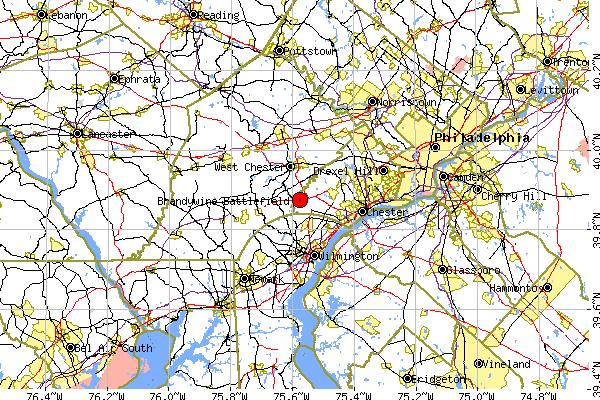
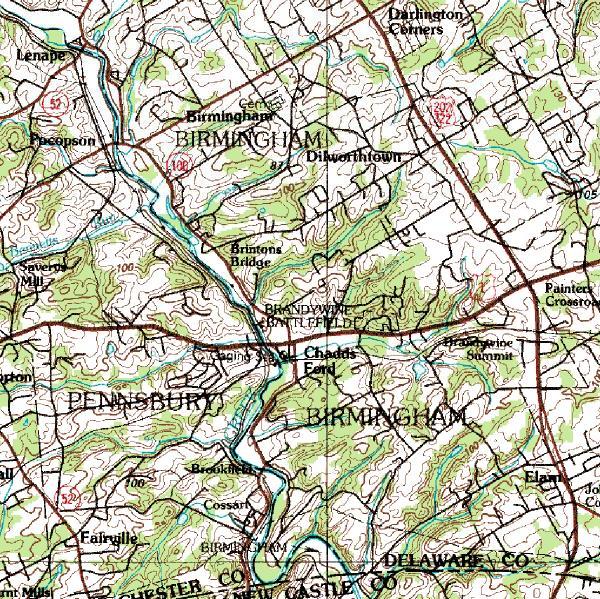
September 9, 1777 Washington Prepares Defenses Philadelphia, the capital of the newly formed nation, was the goal of British General Howe during the campaign of 1777. The British approached Philadelphia from the Chesapeake, landing at Head of Elk, Maryland (present day Elkton). As the British began their march toward the city, Washington and the people of Philadelphia were confident that the British could be stopped. Washington chose the high ground in the area of Chadds Ford to defend against the British advance. Chadds Ford allowed safe passage across the Brandywine River on the road from Baltimore to Philadelphia. On the morning of September 9th Washington placed his troops along the Brandywine River to guard the main fords. By placing detachments of troops at Pyle's Ford -- the southernmost possible crossing of the river -- and Wistar's Ford -- the northernmost crossing of the river before it forked -- Washington hoped to force a fight at Chadds Ford, an advantageous position. Washington believed that he had all of the fords along the Brandywine guarded by his troops and that the closest unguarded ford was twelve miles up-river. Washington was confident that the area was secure. The British grouped at nearby Kennett Square and formulated a plan. A portion of the British army was to march from Kennett Square as if they intended to meet Washington on the banks of the river at Chadds Ford. Meanwhile, the majority of the army under Howe's direction would march north of Wistar's Ford, cross the river at a ford unknown to Washington, and march south into the flank of the American forces. Superior tactics and better knowledge of the area allowed the British to outwit Washington and his army.
September 11, 1777 The day of the battle began with a heavy fog which blanketed the area, providing cover for the approaching British troops. When the fog cleared, the sun blazed and the heat was sweltering. The first reports of British troop movements indicated to Washington that Howe had divided his forces. Subsequent reports both confirmed and denied this report. In the confusion Washington persisted in the mistaken belief that the British were sending their entire force against his line at Chadds Ford. Meanwhile, Howe and the majority of his force continued their approach. By mid-afternoon the British had crossed the river at the unguarded ford to the north of Washington's force and they had gained a strategic position near Birmingham Friends Meeting House. When the British appeared on the American right flank, Washington realized that he had been outmaneuvered. He ordered his army to take the high ground around Birmingham Friends Meeting House as a last defense. Unfortunately, in the confusion caused by the surprise, the Americans were unable to successfully defend their position. The Americans fought valiantly, but they had been outwitted on the rolling hills along the Brandywine. |

|
British Captain John Andre* wrote in his journal, "Night and the fatigue the soldiers had undergone prevented any pursuit."
September 26, 1777
The Result: The British Take Philadelphia
Although the American army was forced to retreat after the Battle of Brandywine, the defeat did not demoralize the men. They believed the defeat was not the result of poor fighting ability but rather because of unfamiliarity with the landscape and poor reconnaissance information.
During the next several days, General Howe and his Army moved closer to Philadelphia with little opposition from Washington. The two armies maneuvered in hopes of finding the other at a disadvantage, but no decisive military actions were taken during the next two weeks. Congress abandoned Philadelphia and moved first to Lancaster and then to York to escape before the British takeover. Important military supplies were moved out of the Philadelphia area to Reading, Pennsylvania, where they could be defended. Washington responded cautiously after the battle. The impending loss of Philadelphia hurt the patriot cause, and Washington's force had dropped from a high of nearly 15,000 prior to the battle to only 6,000.
Washington wrote to Alexander Hamilton on the 22nd, "The distressed situation of the army, for want of blankets and many necessary articles of clothing, is truly deplorable, and inevitably must bring destruction to it, unless a speedy remedy is applied." Local leaders did what they could to supply the army with food and clothing. Reinforcements sent by Congress began to arrive, and Washington felt the army was sufficiently ready to mount an attack. However, it was too late to save Philadelphia, for on September 26th a column of British soldiers marched into the patriot capital unopposed.
Independence Hall Association. The Philadelphia Campaign, 1777: The Battle of Brandywine. ushistory.org, 2004.
http://www.ushistory.org/brandywine/thestory.htm
http://www.ushistory.org/march/phila/brandywine.htm
*It was the discovery of John Andre behind Continental lines with plans for the fortification of West Point and a pass from General Benedict Arnold that led to the discovery of Arnold's treason. Andre was hung as a spy.
 |
|
October 2, 1777
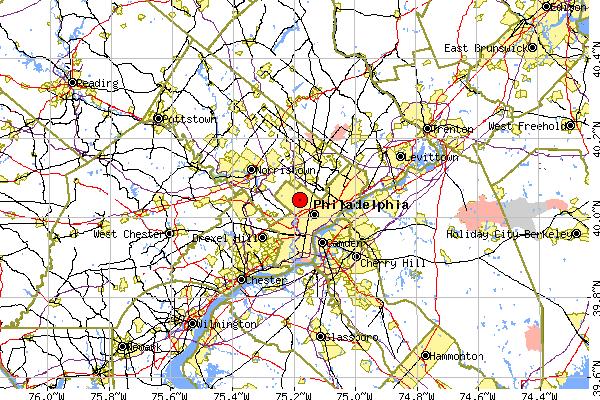
Washington conceived a bold plan of attack on Howe's 9,000 troop garrison stationed in Germantown. It called for the simultaneous advance of four different units of troops -- moving by night. At dawn, the four columns were to converge not far from General Howe's headquarters and catch the British by surprise.
The morning started well for the Americans who had the British retreating. But Washington's plan went astray when one of his four columns lost its bearings in a dense fog and thick smoke. Others columns failed to coordinate effectively.
The British defense was particularly strong at a Germantown mansion named Cliveden where dozens of soldiers had taken refuge. Valuable time was lost while the Americans under Henry Knox bombarded the house. Those inside did not surrender because they feared that Anthony Wayne's men, still furious over the Paoli Massacre, would kill them anyway.
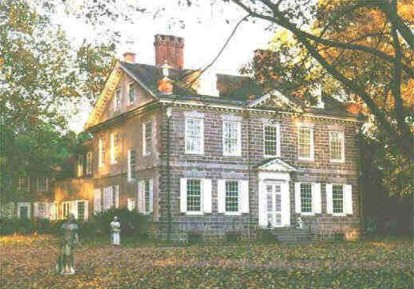
Cliveden
In the end, bad luck and poor timing forced Washington to retreat to Whitemarsh with the British in pursuit. The Battle was an American defeat but it served to boost morale and self-confidence. They believed the defeat was the result of bad luck, not poor tactics. The Americans suffered 152 losses, 521 wounded, and over 400 captured. The British casualties numbered 537 plus 14 captured.
Independence Hall Association. The Philadelphia Campaign, 1777: The Battle of Germantown. ushistory.org, 2004.
http://www.ushistory.org/march/phila/germantown.htm
http://www.ushistory.org/march/phila/togermantown.htm
 |
|
 |
|
November 2-December 11, 1777
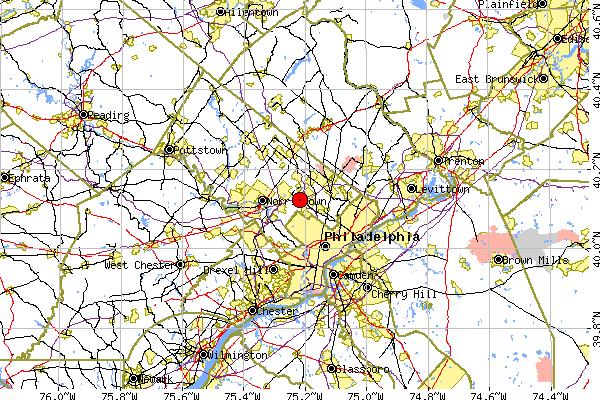
The Continental Army spent six weeks encamped at Whitemarsh. From the hills at Whitemarsh, General Washington was able to both protect the supply cities of the west and monitor the British, who were occupying Philadelphia.
Early in December, General Howe tried to launch a surprise attack on the American position. But the British plan had been ferreted out by spies, and the Americans were well prepared for their expedition. On December 5, the British began a probe of the American position in the hills. Three days of non-decisive skirmishing followed, after which the British returned to Philadelphia. It was the last engagement in the campaign of 1777.
Both armies now turned their thoughts to winter encampment. The British would remain snug in Philadelphia. The Americans marched to a small Schuylkill River village called Valley Forge.
Independence Hall Association. The Philadelphia Campaign, 1777: Whitemarsh. ushistory.org, 2004.
http://www.ushistory.org/march/phila/whitemarsh.htm
At the beginning of November, the army took up a strong defensive position at Whitemarsh, a naturally protected hilly spot a few miles northwest of Germantown. Whitemarsh was excellently situated to serve as a base for covering the country against British foraging, for a possible offensive, and for reinforcing the Delaware forts. Here Washington waited to see what the British were planning, and left the question of quarters for later deliberation. During November Howe's forces secured their hold on Philadelphia by capturing the Delaware River forts and by constructing strong works north of the city. Washington, meanwhile, raised the question of attacking Philadelphia three times in November and early December, and each time the generals in the Council of War voted it down. What seems to have clinched Washington's determination not to attack was his reconnoitering of the British works on November 25. As he informed his officers, from the west bank of the Schuylkill "I had a full view of their left and found their works much stronger than I had reason to expect from the Accounts I had received." Because of his observations, Washington now was ready to settle the army in quarters. He probably calculated that it would remain quartered, undertaking no further offensive operations, until spring.
Benjamin H. Necomb. The Papers of George Washington. "Washington's Generals and the Decision to Quarter at Valley Forge."
http://gwpapers.virginia.edu/valleyforge/
 |

|
 |

|
 |

|
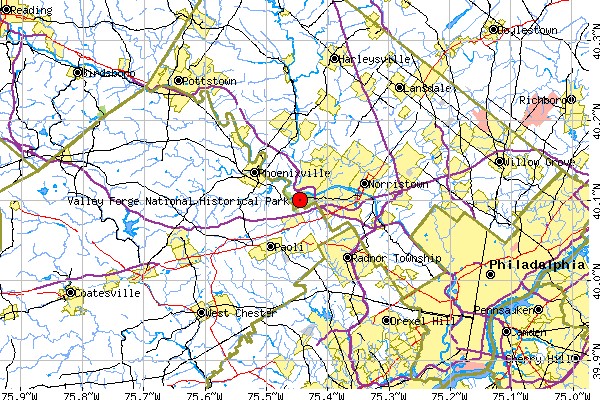
As the Continental Army moved into Valley Forge in the winter of 1777-78, they began a long season of terrible suffering tempered by great rewards. Many of the 6000 men that stayed with Washington that winter had no shoes, pants or blankets. There were weeks when food was extremely limited, so much so that men boiled their shoes and ate them. Albeit the suffering those men endured was purely courageous, it was largely unneccessary. The supply and transport system had become greatly incapacitated by the dissolving of the upper levels of the Quartermaster and Commissary Corps during mid 1777. Many in these corps found the private trade more lucrative.
Regardless, Washington and the Continental Army endured and gained much hardiness due to both the hardships and the arrival of Friedrich Wilhem von Steuben. Steuben arrived in February of 1778 from Prussia where he had been a Captain under Frederick the Great. Washington saw the need for uniform training and organization in his command and gave von Steuben a chance to manifest those goals.
After a short trial period, von Steuben was appointed Inspector General in charge of a training program. During the winter and spring of 1778 von Steuben taught the Continental Army a simplified but effective version of the drill formations and movements of European armies. He also taught them the proper care of equipment and the use of the bayonet, a weapon that the British were far superior with in the past. He made progress in consolidating under-strength elements and also developed light infantry companies as the army's elite force. He took constant measures to impress upon the officers their obligation to be responsible for their men. His successes were greatly built upon his recognition of the American soldier as a citizen-soldier, versus the European professional. His training philosophy incorporated this insight by understanding the need to tell the Americans why they needed to do the things they were instructed to do.
In all, von Steuben's good humor, incessant use of profanity, and understanding of the men under him made the rigors of his intense training more palatable and even entertaining to the soldiers. The end result was a far more effective force that would fight on equal terms against the British Regulars.
Worcester Polytechnic Institute Department of Military Science
http://www.wpi.edu/Academics/Depts/MilSci/BTSI/abs_valley.html
With the winter setting in, the prospects for further campaigning were greatly diminished, and Washington sought quarters for his men. Though several locations were proposed, he selected Valley Forge, 18 miles northwest of Philadelphia. It proved to be an excellent choice. Named for an iron forge on Valley Creek, the area was close enough to the British to keep their raiding and foraging parties out of the interior of Pennsylvania, yet far enough away to halt the threat of British surprise attacks. The high ground of Mount Joy and Mount Misery, combined with the Schuylkill River to the north, made the area easily defensible.
On December 19, 1777, when Washington's poorly fed, ill-equipped army, weary from long marches, struggled into Valley Forge, winds blew as the 12,000 Continentals prepared for winter's fury. Grounds for brigade encampments were selected, and defense lines were planned and begun. Within days of the army's arrival, the Schuylkill River was covered with ice. Snow was six inches deep. Though construction of more than 1,000 huts provided shelter, it did little to offset the critical shortages that continually plagued the army.
Soldiers received irregular supplies of meat and bread, some getting their only nourishment from "firecake,"" a tasteless mixture of flour and water. So severe were conditions at times that Washington despaired "that unless some great and capital change suddenly takes place ... this Army must inevitably ... Starve, dissolve, or disperse, in order to obtain subsistence in the best manner they can." Animals fared no better. Gen. Henry Knox, Washington's Chief of Artillery, wrote that hundreds of horses either starved to death or died of exhaustion.
Clothing, too, was wholly inadequate. Long marches had destroyed shoes. Blankets were scarce. Tattered garments were seldom replaced. At one point these shortages caused nearly 4,000 men to be listed as unfit for duty.
Undernourished and poorly clothed, living in crowded, damp quarters, the army was ravaged by sickness and disease. Typhus, typhoid, dysentery, and pneumonia were among the killers that felled as many as 2,000 men that winter. Although Washington repeatedly petitioned for relief, the Congress was unable to provide it, and the soldiers continued to suffer. Women, relatives of enlisted men, alleviated some of the suffering by providing valuable services such as laundry and nursing that the army desperately needed.
Upgrading military efficiency, morale, and discipline were as vital to the army's well-being as was its source of supply. The army had been handicapped in battle because unit training was administered from a variety of field manuals, making coordinated battle movements awkward and difficult. The soldiers were trained, but not uniformly. The task of developing and carrying out an effective training program fell to Baron Friedrich von Steuben. This skilled Prussian drillmaster, recently arrived from Europe, tirelessly drilled and scolded the regiments into an effective fighting force. Intensive daily training, coupled with von Steuben's forceful manner, instilled in the men renewed confidence in themselves and their ability to succeed.
The passing weeks of winter saw the army, under Washington's inspirational leadership, undergo a dramatic transformation. Slowly but steadily the endurance, bravery, and sacrifice of the soldiers began to tell. Increasing amounts of supplies and equipment came into camp. New troops arrived. Spring brought word of the French alliance with its guarantees of military support. Now a strong, dependable force, well-trained and hopeful of success, drilled on the Grand Parade.
National Park Service. Valley Forge National Historical Park.
http://www.nps.gov/vafo/home.htm
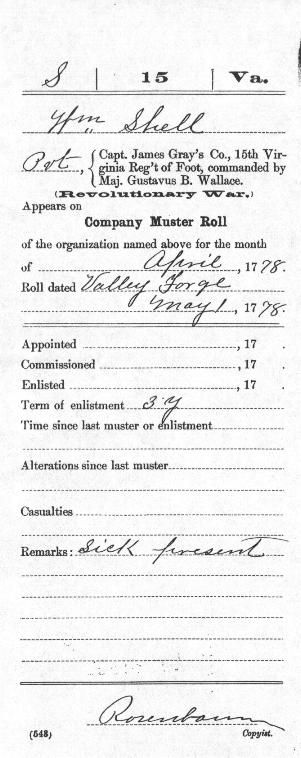 |

|
George Washington at Valley Forge,
April 21, 1778
 |
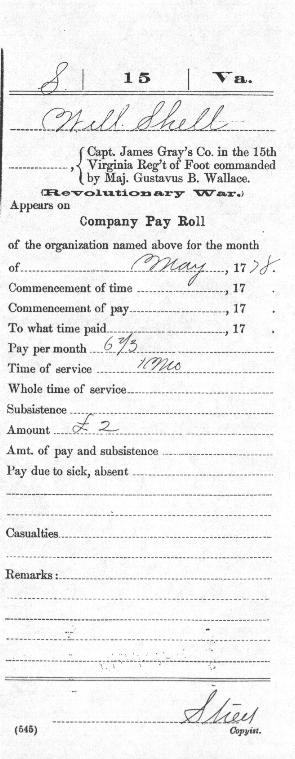
|
The drooping spirits of the weary soldiers must have been greatly revived when the spring came again, and when, in May, the news of the alliance with France was promulgated in camp.
The troops were drawn up in line, and the men placed in specified positions, to fire a salute with muskets and cannon. They fired from right to left, huzzaing "Long live the King of France." Then from left to right, and "Three cheers for the Dauphin." Then another three cheers for the "Independence of the American Colonies," and then it was ordered that full rations of rum be furnished the men, and they drink the health of the King of France, to which they added, "and to our commanding General."
Barton Haxall Wise, ed. Jeffrey C. Weaver. Memoir of General John Cropper of Accomack County, Virginia.
http://www.ls.net/~newriver/va/cropper.htm
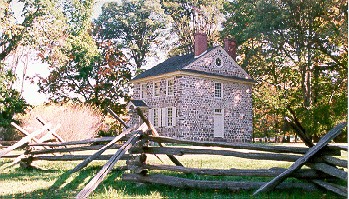 Washington's headquarters in the home of Isaac Potts. |
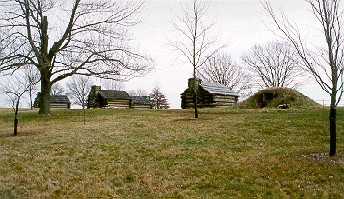 Soldiers' hut replicas. |
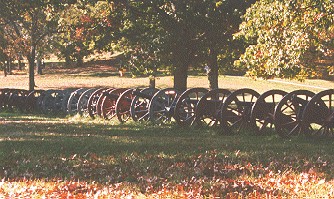
Most of the cannon brought to Valley Forge were massed in the Artillery Park. Here, under the command of Brig. Gen. Henry Knox, artillery was stored and repaired and gun crews were trained and drilled. In the event of an attack, the cannon could be dispatched from this central location to wherever they were needed.
National Park Service. Valley Forge National Historical Park.
http://www.nps.gov/vafo/home.htm
 |
|
Soon word of the British departure from Philadelphia brought a frenzied activity to the ranks of the Continental Army. On June 19, 1778, six months after its arrival, the army marched away from Valley Forge in pursuit of the British who were moving toward New York. An ordeal had ended. The war would last for another five years, but for Washington, his men, and the nation to which they sought to give birth, a decisive victory had been won -- a victory not of weapons but of will. The spirit of Valley Forge was now a part of the army and because of it the prospects for final victory were considerably brighter.
National Park Service. Valley Forge National Historical Park.
http://www.nps.gov/vafo/home.htm

As British General Clinton prepared to evacuate Philadelphia there was strong sentiment in the Continental Army command that a cooperative effort between their army and the newly allied French naval fleet might result in winning the war. A French naval squadron consisting of 11 war ships along with transports carrying 4000 French troops sailed from France in May of 1778 and headed to America. The fleet, commanded by Comte d'Estaing, was far superior to any Admiral Howe (British) could immediately concentrate in American waters. This represented a stronghold on strategic initiative in favor of the Americans on which General Washington hoped to capitalize.
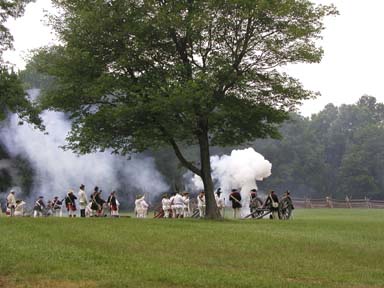
Continental artillery at Monmouth.
Clinton received orders from England to detach 8000 of his roughly 10,000 man force to the West Indies and Florida and evacuate the rest of his men from Philadelphia to New York by sea. Instead, Clinton decided to move the entire army to New York before making any detachments and to move them overland. His decision was largely based on the fact that he didn't have the transports to move his 3000 horses over sea. Clinton set out from Philadelphia with his 10,000 men, to include Tories from the region, on 18 June 1778. Washington and his growing army of 12,000 men immediately occupied Philadelphia and began pursuit of Clinton towards New York.
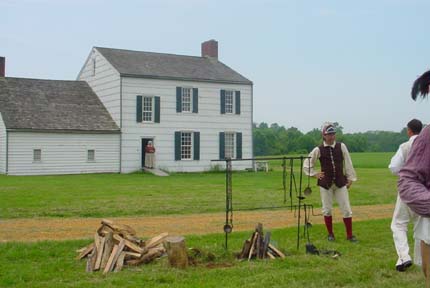
The home of John and Ann Craig and their three children. According to family tradition, the Craigs hid their silverware in the well before fleeing their farm. During the battle, thirsty British troops drained the well and found the silver at the bottom.
Washington was still undecided as to whether he should risk an attack on the British column while it was on the march. He held a meeting of his command staff, the Council of War, and attempted to find some resolve in that matter. The council, however, was quite divided on the issue. The only unifying theme was that none of Washington's generals advised in favor of a general action. Brig. Gen. Anthony Wayne, the boldest of the staff, and Maj. Gen. Marquis de Lafayette, the youngest of the staff, urged for a partial attack on the British column while it was strung out on the road. Gen. Lee, who had been captured and exchanged and had rejoined the army at Valley Forge, was the most cautious. He advised only guerilla action to harass the British column. On 26, June 1778, Washington sided with a more bold approach but did not go so far as issuing orders for a general action. He sent almost one-half of his army as an advance force to strike at the rear of the British when Clinton made the eminent move out of Monmouth Courthouse, which occurred on 28, June 1778.
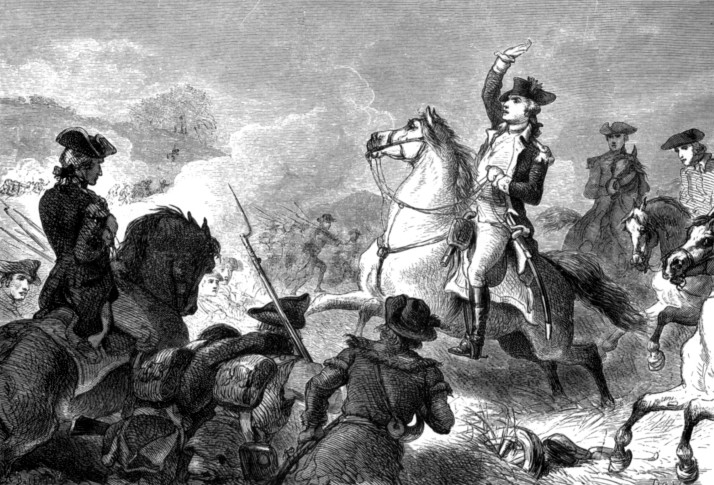
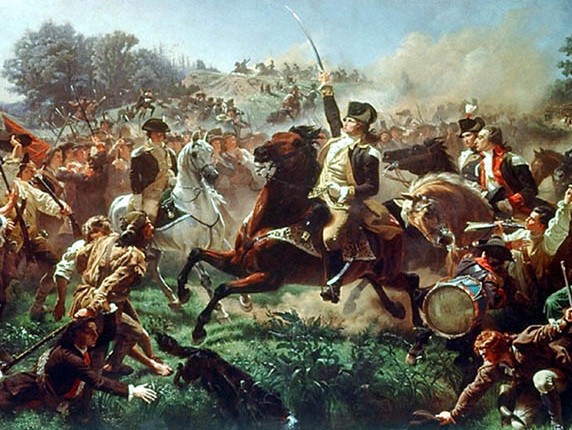
Gen. Washington halting Gen. Lee's retreat.
Early in the morning on 28 June, Lee advanced upon unreconnoitered ground and made contact with the British rear guard at Monmouth Courthouse. Clinton reacted quickly and maneuvered to envelop the American right flank. Lee felt that he was then faced by a superior force and fell into a retreat that seems to have been quite confused. Washington was quite irate at the retreat and spoke harshly at Lee. Washington then assumed a defensive position to repel a possible British counter-attack.
The ensuing battle, involving the bulk of both armies, was fought on that hot, sultry day and continued until nightfall with both sides holding their original positions.
| Continental | British |
|---|
|
Washington and main force go into bivouac 20 miles away from Monmouth Courthouse in town of Cranbury.
Advance force (about half of total force) led by Lafayette moves ahead to prepare for attack on Clinton when he leaves Monmouth. |
Arrive at Monmouth Courthouse in the afternoon after a 19-mile road march in deep sand.
Many of the heavily burdened troops die from heat exhaustion. Positions are built that allowed for attack, defense or retreat. |
|
Lee takes charge of advance force at Englishtown 5 miles from British. Washington moves main body 8 miles west of British and 3 miles from Lee as support force to Lee.
N.J. Militia Gen. Dickinson and 1000 men move to British west flank as scout/intel force. Col. Morgan of N.J. Militia flanked British on east with 600 riflemen. Col. Moylan's mounted regiment screened roads ahead of suspected British retreat to provide intel. Lee informs his officers that he intends to play his attack "by ear" in the case of minimum intel. |
Clinton prepares for 4:00 AM June 28 retreat toward Sandy Hook.
Defenses reinforced to allow rear guard to act as delaying force during successive retreat by echelon. |
| 4:00 AM: Dickinson observes Knyphausen's movement and has report to Washington by 5:00 AM. |
Clinton sends Knyphausen north toward Middletown with his element and the baggage/supply train.
Clinton keeps Cornwallis' command attached to him as the main delaying/defense force. |
|
6:00 AM: 5 hours late, Lee begins the recon of attack routes and of enemy positions he was ordered to do at 1:00 AM.
Col. William Grayson is sent toward British with 4 guns and 600 men. |
|
|
7:00 AM: Lee begins to move main element toward Monmouth Courthouse.
Dickinson retreats across swamp of West Ravine when enemy security patrol advances against him. Grayson arrives and links-up with Dickinson and combined element regains lost ground. Lee arrives and gets conflicting reports about whether or not Clinton had begun his withdrawal which leads to dispute between Lee and Dickinson. Wayne ordered forward to command Grayson's advance guard. Lee advances to position between East Ravine and enemy's line of retreat. |
Security patrol makes contact with Dickinson's element and pushes toward them. |
| 8:00 AM: | Main body of Cornwallis' division and Clinton's command begin to evacuate Monmouth Courthouse and leaves sizable rear guard detachment. |
| 10:00 AM: Lee launches unplanned attack on Cornwallis' detached rear guard which turns into confused retreat. | Rear gaurd attacked by Lee and manuevers into counter-flanking position. |
|
After 10:00 AM: Lee's retreat moves back 3 miles and meets Washington's main body.
Washington moves forward and takes command of both elements and forms final defensive line. |
Clinton orders elements of Knyphausen's command to move back to Monmouth Courthouse and to also cover the northern flank of the supply column. |
| Lee's botched attack reveals to Clinton that Washington's main body is nearby. | Clinton turns back toward Monmouth to face Lee. |
Molly Pitcher
Born in 1754, Mary Ludwig Hays McCauley was the daughter of a New Jersey dairy farmer. At the age of 13, she went to work as a domestic/servant. During the same year, still at 13, she married a man by the name of William Hays (a barber). When the Revolutionary War began, William enlisted and became a gunner in the Pennsylvania Artillery. Mary joined her husband as a campfollower during the Philadelphia Campaign (1777-1778) in New Jersey eventually wintering with the Army at Valley Forge.
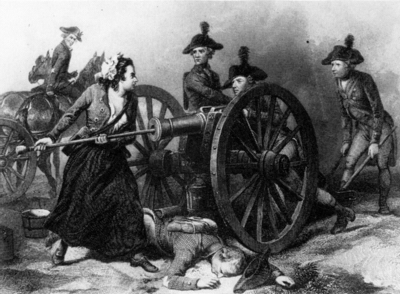
We all have come to know her as "Molly Pitcher." She gained this title later on at the Battle of Monmouth. The only contemporary witness to the scene in June of 1778 describes the scene of the husband and wife, Mary and William, working together: "A woman whose husband belonged to the artillery and who was then attached to a piece in the engagement, attended with her husband at the piece the whole time. While in the act of reaching a cartridge and having one of her feet as far before the other as she could stemp, a cannon shot from the enemey passed directly between her legs without doing any other damage than carrying away all the lower part of her petticoat. Looking at it with apparent unconcern, she observed that it was lucky it did not pass a little higher, for in that case it might have carried away something else, and continued her occupation."
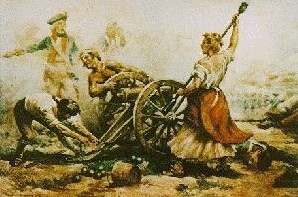
At the close of the War, William and Mary Hays returned to Pennsylvania. They settled in Carlisle where Mary went back to work as a domestic as well as a "charwoman" in the State House in Carlisle. After the death of William, Mary remarried another Revolutionary War veteran by the name of John McCauley. She was awarded a pension in 1822 by the Pennsylvania State Legislature and it wasn't until the anniversary of the War in 1876 that a marker, noting her exemplary service, was placed on her grave. She died on January 22, 1832.
Independence Hall Association. USHistory.Org.
http://www.ushistory.org/valleyforge/youasked/070.htm
Lt. Col. John Cropper
Soldier, born in Virginia in 1756; died at Bowman's Folly, Accomac County, Virginia, 15 January 1821. He was a captain in the 9th Virginia regiment of the Revolutionary forces in 1775, was soon promoted to be major of the 5th, engaging in the battle of Brandywine, where his regiment suffered severely, and became colonel of the 7th, taking part in the battles of Germantown and Monmouth. He was made lieutenant colonel of the llth regiment on 15 May 1778, and afterward promoted to be its colonel.
Edited Appletons Encyclopedia, Copyright © 2001 VirtualologyTM
http://www.famousamericans.net/johncropper/
At the battle of Monmouth, Morgan was not present, and Cropper, as lieutenant-colonel, was at the head of the Eleventh, and his men fought throughout that hot and sultry June day, when the American troops suffered so for water that many died from thirst, and when Washington, losing his temper, swore, according to a gallant officer, "like an angel" at General Charles Lee. On the morning after the retreat of the British, the Virginia riflemen followed on the trail of the enemy, making a number of captures, and among other things the coach of a general officer.
Recollections of G.W.P. Custis, p.226.
Barton Haxall Wise, ed. Jeffrey C. Weaver. Memoir of General John Cropper of Accomack County, Virginia.
http://www.ls.net/~newriver/va/cropper.htm
 |

|

A frontiersman and Continental officer, Daniel Morgan was a first cousin of the notorious Daniel Boone. At the early age of 22 his efforts against the British began when he hit back after a British officer had slapped him with the flat of his sword. He later redirected his efforts by receiving a Continental Commission as a captain of a Virginia rifle company on 22 June 1775. His company led Benedict Arnold's march to Quebec from September to November of 1775 and he temporarily took command after Arnold had been seriously wounded in the leg. Taken prisoner during that engagement, Morgan was paroled the next summer and exchanged in the fall. On 12 November 1776 he was commissioned Colonel of the 11th Virginia Regiment. He joined General Washington's army in April 1777 and raised a force of 500 sharpshooters known as Morgan's Continental Rifle Corps.
Worcester Polytechnic Institute Department of Military Science
http://www.wpi.edu/Academics/Depts/MilSci/BTSI/glossary.html#militia
Daniel Morgan (1736-1802), was a general in the American Revolution, who defeated the British at the Battle of Cowpens. He was born near Junction in Hunterdon County, New Jersey, but moved to Virginia in 1753. Morgan served in the French and Indian War and later took part in several campaigns against the Native Americans.
Daniel Morgan was born in Hunterdon County, N.J., in 1736, and died July 6, 1802. Morgan was the commander of a band of Virginia sharpshooters in the American Revolution. At the outbreak of the Revolution he was commissioned captain in the Continental Army, and he went with Benedict Arnold on the expedition (1775) against Québec, where he distinguished himself as commander after Arnold was wounded. Taken prisoner, he was exchanged in the fall of 1776 and commissioned a colonel.
He fought in the battles of Saratoga in the fall of 1777. He and his frontier riflemen played a major part in defeating the British at Freeman's Farm and Bemis Heights. Dissatisfied and in ill health, Morgan retired from the army in 1779 but reentered as brigadier general in 1780. On January 17, 1781, promoted to brigadier general, he won one of the most brilliant victories of the war when he overcame a superior British force (commanded by Col. Banastre Tarleton) by his effective use of cavalry at the battle of Cowpens, South Carolina.
After the war Morgan commanded troops in western Pennsylvania charged with suppressing the Whiskey Rebellion. He served as a Federalist representative in Congress from 1797 to 1799.
Callahan, North. Daniel Morgan, Ranger of the Revolution (1961).
Higginbotham, Don. Daniel Morgan, Revolutionary Rifleman (1961).
"Morgan, Daniel," Encarta Encyclopedia 99.
http://www.americanrevwar.homestead.com/files/MORGAN.HTM
 |

|
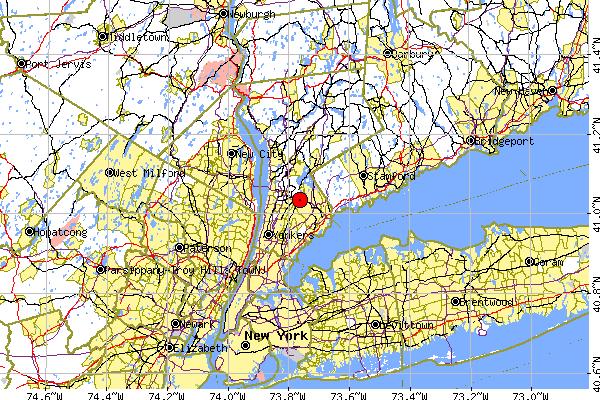
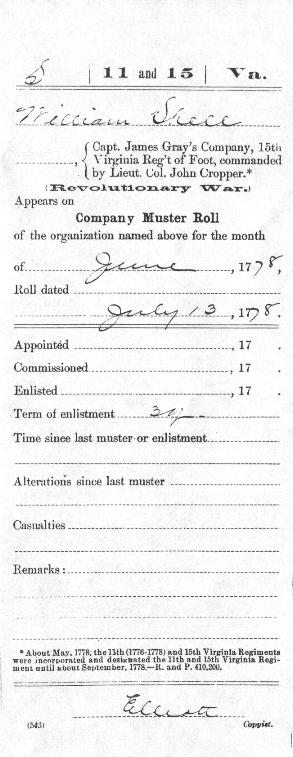
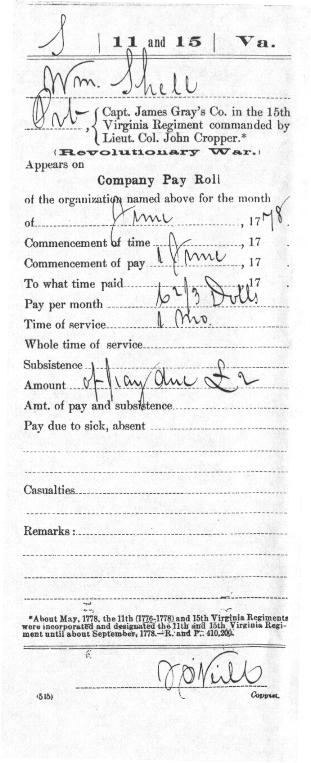
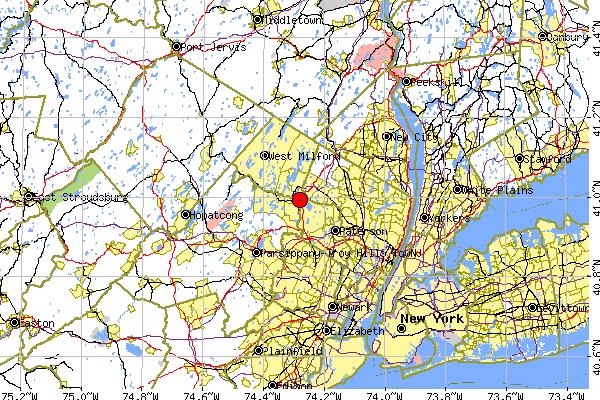
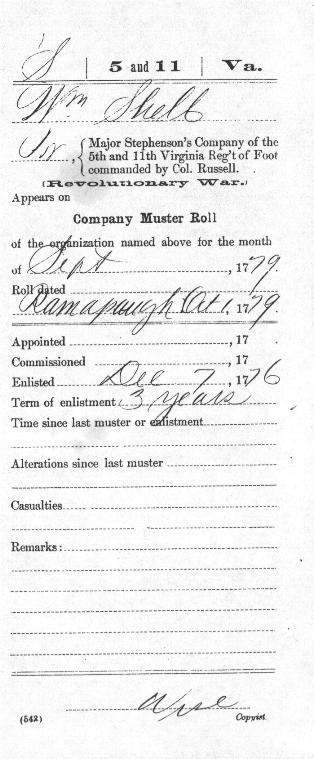
Shortly after the Battle of Monmouth, the Continental troops returned to camp at White Plains, New York behind fortifications lost to the British in the Battle of White Plains on October 28, 1776 following the evacuation of New York. One of the two August muster rolls for the 11th & 15th Virginia Regiments shows William Shell "absent."
 |
 |

|
 |

|
 |
|
He was born in Culpeper County, Virginia, in 1749, into a well-to-do family descended from members of the Beauford family who had emigrated from England in the 1630s. (In the 1780s, the name still frequently appeared as "Beauford" in contemporary documents.) Although he was well into his twenties when the war began, he had not yet settled on a career.
In November, 1775, he raised a company of minutemen in his local area, the Culpeper District Battalion. They saw some action early in the war. Two of "Captain Buford's" men were killed during the bombardment of Norfolk (New Year's Day, 1776).
From 1776 to 1778, Buford served with a variety of Virginia regiments, and worked his way up the chain of command without accumulating any particular laurels. On Nov. 13, 1776, he became a major with the 14th Virginia Regiment, and on April 1, 1777, he was promoted to lieutenant-colonel and transferred to the 5th Virginia Regiment. The 5th was present at various battles in the north, including Brandywine and Germantown. Presumably Buford was there with them, but I could find no information on the extent or nature of their participation in these battles.
He spent the winter of 1777-78 at Valley Forge. On February 18th, Washington's general orders list "Lieut. Colo. Beauford" as having served as president of a brigade courtmartial. On May 15, 1778, he was promoted to colonel of the 5th Virginia, which formed part of the rebel force which pursued Sir Henry Clinton's army from Philadelphia to New York. On Sept. 14, 1778, he was transferred to the 11th Virginia Regiment, and remained their colonel until Feb. 12, 1781.
Marg Baskin. Friends, Comrades, and Enemies: Abraham Buford (1749-1833).
http://home.golden.net/~marg/bansite/friends/buford.html
 |

|

At Middlebrook Encampment, following the battle of Monmouth, Washington took the American Army north to the Highlands to guard the Hudson River against the British Army, which had moved back into New York City. He decided to place the main portion of the army in New Jersey, near the village of Middlebrook in Somerset County, where they could protect New Jersey, threaten New York and Staten Island, and quickly reinforce the Highlands.
National Park Service. Crossroads of the American Revolution in New Jersey.
http://www.nps.gov/crossroads/chrono.htm

Continental Encampment at Middlebrook shaded in blue.
Winter encampments were the necessary acknowledgements of rest and repair that eighteenth century armies gave to the harsher weather and energy requirements of the season. Middlebrook, as it was known, is the name given to the tributary that runs from the Watchung hills down through the gorge at Chimney Rock above contemporary Bound Brook. The Revolutionary garrison formed in the area, and the cantonment included the colonial bridge sites across the Raritan in what is now modern Bound Brook. From the heights above the flats of Bound Brook, and along the Watchung ridge, commanding views east and southeast to old Elizabethtown and the Amboys, were available; similarly to the south and southwest to New Brunswick and Princeton. If an immediate strategic retreat were called, the relative safety in the foothills of Morris and Sussex lay just behind to the north.
The strategic location would find further use at what is known as the Second Middlebrook Encampment, with the winter reserve of American forces as they faced the continuing occupation of New York by the British, following the rebels' victory at the Battle of Monmouth in 1778. The Second Encampment is remembered for the contribution of its commanding General Washington, and of Von Steuben, Inspector General of the Continental army who is credited with harnessing the social energies of revolution into the disciplined fighting force that American regulars needed to become in order to defeat the larger and more well financed British army of occupation.
Weldon Monsport. The Battle of Bound Brook.
http://www.njskylands.com/hsBoundBrook.htm
 |
 |
 |
 |
 |
|
 |
 |
 |
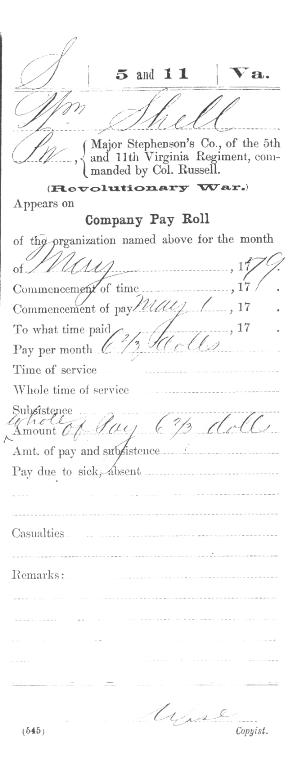 |
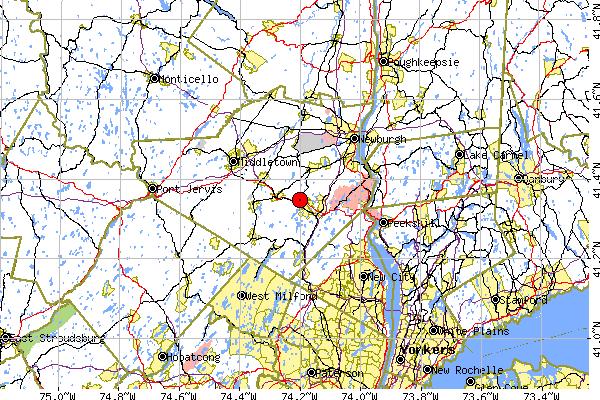
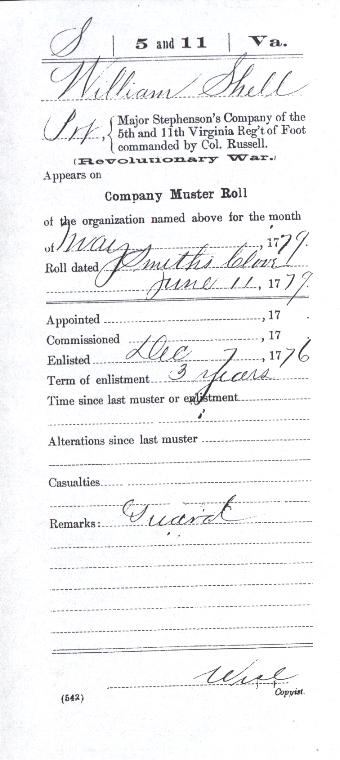
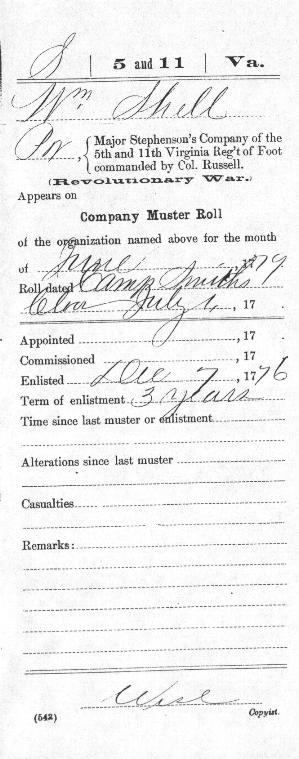
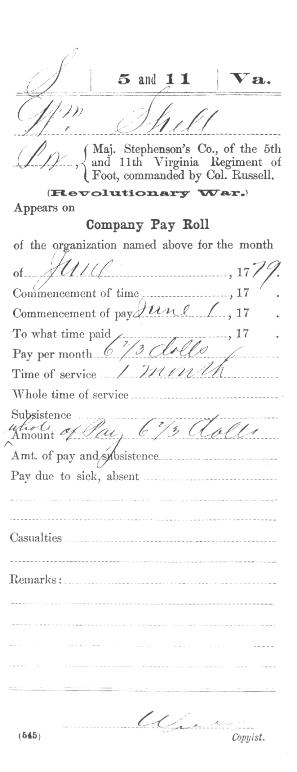
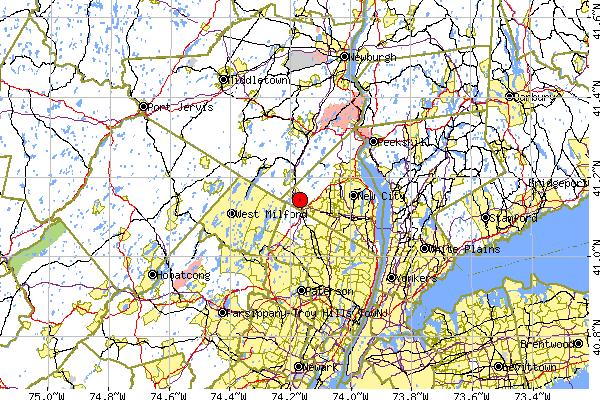
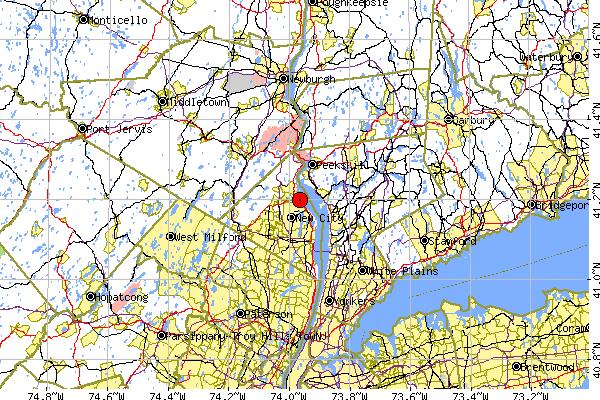
On May 30, 1779, Clinton captured Stony Point, New York. Washington positioned his troops at Smiths Clove, New York, between Clinton and West Point, fearing that to be Clinton's objective, but Clinton moved back down the river. One officer described Smiths Clove as "a most villainous country, rough, rocky and bad climate."
Fleta Aday. Charles Powell in the Revolution.
http://www.cswnet.com/~brenfroe/cprev.htm
 |
|
 |

|
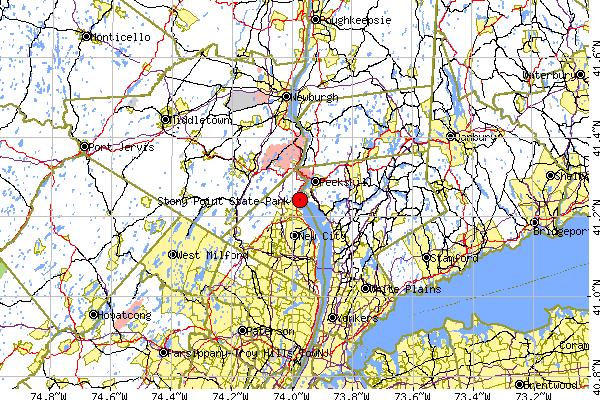
The British had captured the peninsula of Stony Point in May 1779, and began to fortify it by erecting an earthen fort and two barriers called abatis. Sir Henry Clinton garrisoned Stony Point and Verplanck's Point with about 1,000 men to protect the King's Ferry, which crossed the Hudson River between the two posts. Clinton then launched raids against Connecticut coastal towns, in a continuing attempt to lure Washington into battle.
 Verplanck Point with Stony Point across Kings Crossing in the background. |
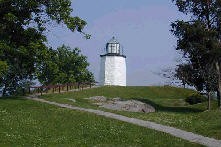 Stony Point Lighthouse |
The victory at Stony Point was the last major battle in the north. Of the 11 decorations for bravery awarded by Congress during the Revolutionary War, three officers were presented with medals for their bravery in this battle. Clinton's plan to defeat the Continentals and end the war had failed.
Fleta Aday. Charles Powell in the Revolution.
http://www.cswnet.com/~brenfroe/cprev.htm
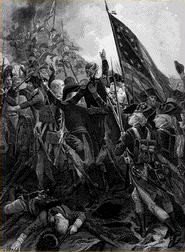
In the early morning hours of July 15th, three columns of continental soldiers, 1200 men in all, converged on the fort. The fort was swiftly overwhelmed. Fifteen American soldiers were killed and 83 were wounded. Of the redcoats troops, 63 were killed, 74 were wounded and 543 were taken prisoner.
American Revolution.
http://www.americanrevolution.com
Gen. George Washington to Gen. Benedict Arnold
Headquarters, West Point, NY
July 20, 1779.
You will have heard of the success of our Arms on the night of the 15th, against the Garrison at Stoney point; and as it is probable that you will see the particulars soon after this comes to hand, and I am extremely busy, I shall not trouble you with a detail of the Affair. The event is very interesting, and the conduct of the Officers and Men engaged in the enterprize does them the highest honor.
Electronic Text Center, University of Virginia Library. The writings of George Washington from the original manuscript sources.
http://etext.lib.virginia.edu/washington/
 |

|
 |

|
 |

|
 |
|
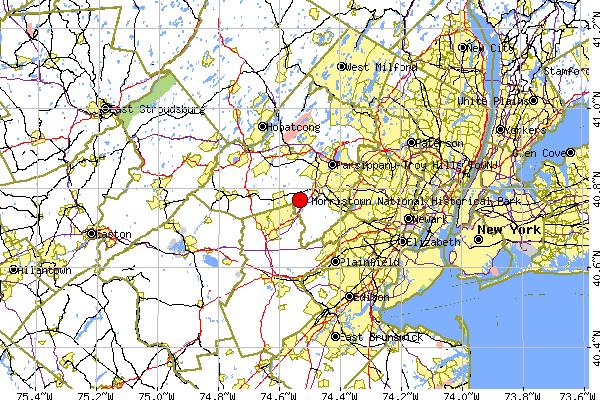
Perhaps it is because there were no great battles at Morristown that historical texts often gloss over the events here and focus on more catastrophic circumstances such as those at Valley Forge. The Jockey Hollow encampment of 1779-80 endured a winter more severe, including seven blizzards in December alone, than that at Valley Forge, where thousands died. Yet only about a hundred soldiers at Morristown did not see the spring of 1780.
Nine hundred acres of Jockey Hollow timber, notched together and chinked with clay, made the army's winter quarters-- 12 soldiers in each of 1,000 14 x 16 huts-- where the men made do with a trickle of rations and beds of loose straw. A thousand soldiers deserted; most remained. Although there was no great turning point, had the battle waged here to keep the Continental Army intact failed, then Yorktown, the battle where the Continental Army gained final advantage in the War, would have a far different meaning in our lives.
When the Jockey Hollow encampment made Morristown one of the ten largest cities in the Colonies by the spring of 1780, it was only the apex of the tiny village's eight year involvement in the conflict. By late 1779, the consistent military presence for munitions and supplies, constant procession of refugees, and a litany of Loyalist trials, jailings, and hangings gave the Patriot stronghold a war-weary atmosphere we might liken to modern day Bosnia. In fact, the army had wintered there 3 years before in 1777 following Washington's Christmas Delaware crossing and victories at Trenton and Princeton. Although far fewer troops accompanied the General the first time, the impact on the citizenry was catastrophic as nearly one quarter of the population died from small pox or dysentery. Washington, headquarterd at Arnold's Tavern on the town green, billeted 3 or 4 men in every house so that it would appear that troop presence was many times more than the few thousand actually there. Needless to say, the attitude was different the second time around, and citizens had by then acquired a lawful right to refuse quartering. A testament to the success of 1779-80 was that, this time, only 25 citizens perished from disease, although when it was over, the state of New Jersey read numerous petitions for grievances from Morristownians trespassed against.
Morristown National Historic Park: The Great Story.
http://www.njskylands.com/hsmtnhp.htm
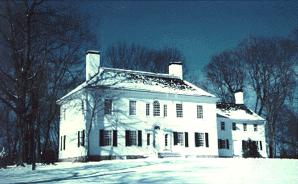
The Ford House
Gen. George Washington's Headquarters at Morristown
This massive Georgian style mansion was built between 1772-1774 for Jacob Ford Jr. Mr. Ford was involved in a number of business ventures including an iron mine, iron forges, a grist mill, a hemp-mill, a gun powder mill and farms. Mrs. Jacob Ford Jr. and her four young children continued to reside in this house after Mr. Ford's death on January 11, 1777. Through the hospitality of Mrs. Ford, General Washington rented this home for the winter of 1779-1780. Consequently, the Ford Mansion, one of the finest homes in Morristown, became General Washington's military headquarters during the winter of 1779-1780. The Ford family was crowded into two rooms of their home during General Washington's stay. General Washington brought with him his Aides-de-Camp and a number of servants to assist him in performance of his many roles and duties. Daily meetings and discussions attempted to solve multiple problemsfacing the army during the winter months inclusive of severe shortages of food rations and supplies. Urgent financial support of state government and the Continental Congress was imperative for clothing and feeding of the army. Military strategy in the northern and southern theaters also had to be worked out with the French. The Ford Mansion is open daily and may be seen by Ranger Guided tours only Tours are given hourly at 10:00 am, 11:00 am, 1:00 pm, 2:00 pm, 3:00 pm and 4:00 pm (July, 1997).
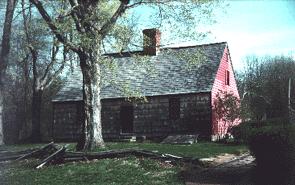
The Wick House
Being one of the most prosperous families of the times, the Wick family lived in a comfortable home whose construction and style reflected their New England origins. The Wick farm included a fine and roomy, well constructed home house with windows, circa 1400 acres of timber land and open fields; a perfect area for Washington's soldiers to camp for for the winter. The Wick farm and adjacent farms grew various crops including wheat, corn, rye, oats, buckwheat, apples and flax. Consequently, the Wick farm and a couple of adjacent farms became home to 13,000 soldiers during the winter of 1779-1780. The Wick farm house became winter headquarters for General Arthur St. Clair. Jockey Hollow was a popular camp ground for General Washington's army. It was used by portions of the Continental Army for a total of 24 months during the American Revolution. The Wick House is open to visitors daily between the hours of 9:30 am and 4:30 pm (July, 1997).
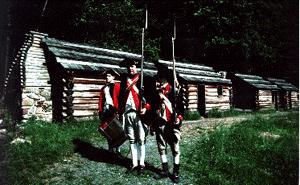
Jockey Hollow reproduction soldiers' huts
When soldiers first arrived in Jockey Hollow for their winter encampment, they had no choice but to sleep out in the open in the snow. Wagons with tents arrived a few days later than did the soldiers. Soldiers remained in the tents until the completion of the wooden huts. The soldier huts used at Jockey Hollow were fourteen feet by sixteen feet and housed twelve men. General Washington ordered that enlisted mens' huts were to be built first. Therefore, officers' huts were not built and completed until all the enlisted men were settled in huts. It took most of the soldiers about two to three weeks to build their huts. The majority of the enlisted men in the Continental Army were poor, lower class men. A good number of these men were not even born in America. Army Officers, on the other hand, were from middle to upper class society and were often land owners. Enlisted men moved into their huts around Christmas. The last of the officers did not get to move into huts until mid February. The 1779-1780 winter at Jockey Hollow was the worst winter in over 100 years. Military camp conditions were so deplorable that many soldiers stole regularly just to eat, deserted, or mutinied. Replica huts can be seen in the Jockey Hollow section of the unit. They are open from dawn to dusk daily (July, 1997).
The National Park Service. Morristown National Historical Park.
http://www.nps.gov/morr/morr1.htm

Request form for William Shell's Revolutionary military service records submitted to National Archives by Rebecca Goff.
 |
 |
*This page was originally posted identifying the William Shell of these records, along with the NSDAR as shown above, with the patriarch of our line (Shells of Pigeon Creek). Shortly thereafter we received information challenging this identity. The argument subsequently submitted is persuasive. Furthermore, in the oral tradition with which we're familiar, our patriarch was not described as a Revolutionary veteran but was a patriot, having contributed a cow and a rifle to the Continental Army. Therefore, we have changed the identity here. However, because this question remains somewhat uncertain and debatable, both William Shell (Shells of Pigeon Creek patriarch) and William Shell are linked to this article and the entire argument for the latter included in an article at http://web.infoave.net/~danshell/ShellWmWhich.htm. We have not received permission to reveal the identity of the author.
Return to Dan & Cindy's home page by clicking HOME.
Click EMAIL to submit corrections, additions, or otherwise let us know
what you think. SURNAMES is the genealogy home page with an index to check
for a connection to your family.
If you find one, let us know!
Page built by Dan Shell on 19 June 2002